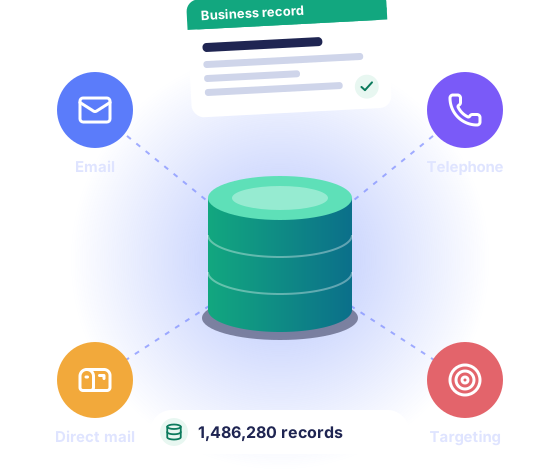
- A marketing database is a list of the businesses (or people) you want to sell to, with the contact details to reach them and the facts to choose them.
- There were 2,786,985 VAT or PAYE registered businesses in the UK in March 2026 (ONS), and 77% of them were companies.
- Buy when you need scale quickly, build when your market is small and specialised, rent for a one-off mailing.
- Our prices run from £170 to £295 per 1,000 records; 10,000 records cost £2,200 plus VAT.
- You can email companies and LLPs without consent; you can't email sole traders or ordinary partnerships from a bought list. Screen phone numbers against the TPS and CTPS.
- Clean the data before every campaign, re-screen phone numbers after 28 days, and measure your own results rather than trusting averages.
01
What is a marketing database?
A marketing database is an organised list of the businesses or people you want to sell to, holding the contact details you need to reach them and the facts you need to choose them. A B2B marketing database lists businesses and their decision-makers; a B2C one lists consumers at home.
You'll also see it called a B2B database, a contact database or a prospecting database. They all mean the same thing: the businesses you want as customers, and how to reach the people who decide.
The phrase gets used for two different things. Some people mean the software that stores customer data (a CRM or customer data platform). Most people searching for marketing databases mean the data itself: a list of prospects to contact. This guide is about the second: UK business data you can buy and use for letters, calls and emails, and how to look after it once you have it.
| B2B (business) | B2C (consumer) | |
|---|---|---|
| Who's on it | Businesses, charities and public bodies, and named people in their work roles | Individuals and households |
| Typical selections | Sector, area, number of employees, turnover, job title | Age, location, lifestyle, homeowner status |
| Email rules (PECR) | Companies and LLPs can be emailed without consent; sole traders and ordinary partnerships need consent | Consent (or the soft opt-in for your own customers) |
| Covered on this site | Yes: UK businesses only | No |
02
What's in a record?
A business record usually holds the business name, postal address, phone number, a named contact and job title, email addresses, website, business category and size. Not every record has every field, so always check the counts for each field before you buy.
- Business name
- Example Dental Care Ltd
- Address
- 1 High Street, Anytown, AB1 2CD
- Telephone
- 01632 960000
- Named contact
- Jane Smith, Practice Manager
- jane.smith@example.co.uk
- Category · size
- Dentists · 10 to 19 employees
One record = one row in your spreadsheet. The example on the left is made up, but it shows the shape of a typical business record: who the business is (1), where to write (2), who to call (3, 4), where to email (5) and the facts you select on (6).
The table below explains what each field is for and what to check before you rely on it.
| Field | What it's for | Worth knowing |
|---|---|---|
| Business name | Addressing letters, matching to your CRM | Trading names and registered names can differ |
| Postal address and postcode | Direct mail, choosing by area, mapping territories | The most complete field in most business data |
| Telephone number | Telemarketing, follow-up calls, appointment setting | Screen against the TPS and CTPS before calling |
| Named contact and job title | Getting past reception to the person who decides | A named person makes the record personal data under UK GDPR |
| Named contact email | Email campaigns to a decision-maker | Usually the scarcest field; check how many records have one |
| General business email (info@, sales@) | Email where no named address is held | Not personal data if it doesn't identify a person |
| Website | Research before a call, checking the business is trading | |
| Business category / SIC code | Choosing by sector | Ask how categories are assigned and how fine they go |
| Employee size band | Choosing by size, matching to your price point | A band, not an exact headcount |
Across the 1,486,280 records we hold, every record has a postal address and a phone number, 1,219,031 have a named contact, 454,737 have a named contact email and 257,860 have a general business email.
03
Types of marketing database: email, telephone and postal
Marketing databases are usually bought for one channel (email, telephone or postal) or for all three together (multi-channel). The channel decides which fields you pay for and which rules apply.
Email marketing database
Records with a named contact email or general business email. Cheapest to use at scale; deliverability and PECR rules matter most. Corporate bodies only, unless you have consent.Telephone marketing database
Records with a phone number, usually with a named contact so callers can ask for the right person. Screened against the TPS and CTPS before you call.Postal (direct mail) database
Records with a full postal address and, ideally, a named contact. Post isn't covered by PECR, so it can reach sole traders and partnerships too.Multi-channel database
Every field we hold for each business, so you can write, call and email the same prospects in a planned sequence. Most buyers choose this.Buying data for email? Our email marketing database guide covers which businesses you can email, named vs general emails by sector, and deliverability. Read the guide.
04
Marketing database vs database marketing, CRM and mailing lists
A marketing database is the data; a CRM is the software you keep it in and record your sales activity in; a CDP joins up data about customers you already have; a mailing list is a single list for one campaign. Database marketing is the practice of using all of this to target and measure campaigns.
| What it is | Holds new prospects? | Typical use | |
|---|---|---|---|
| Marketing database | Data: businesses and contacts with targeting facts | Yes: that's the main point of buying one | Finding and contacting new customers |
| CRM | Software for contacts, deals and activity | Only what you put in it | Managing calls, follow-ups and sales |
| CDP | Software combining customer data from several systems | Mostly existing customers and website visitors | Personalising marketing to known customers |
| Mailing list | A list of postal or email addresses | Sometimes | One campaign or newsletter |
In practice they work together: you buy or build a marketing database, import it into your CRM, and record every contact against each record so you know who to call next and who has asked you to stop.
05
How many UK businesses are there to market to?
There were 2,786,985 VAT or PAYE registered businesses in the UK in March 2026, according to the Office for National Statistics. 89% of them are micro businesses with fewer than 10 employees, and 534,440 are sole proprietors or partnerships, which matters for email.
| Size | Businesses | Share | |
|---|---|---|---|
| Micro (0 to 9) | 2,484,365 | 89% | |
| Small (10 to 49) | 246,285 | 9% | |
| Medium-sized (50 to 249) | 44,875 | 2% | |
| Large (250+) | 11,460 | under 1% | |
| All UK businesses | 2,786,985 | 100% |
UK businesses by legal status, March 2026
- Companies (including building societies)77%
- Sole proprietors14%
- Partnerships6%
- Non-profit bodies and mutuals3%
- Public sector (central and local government, public corporations)under 1%
| Legal status | Businesses | Share | |
|---|---|---|---|
| Companies (including building societies) | 2,155,395 | 77% | |
| Sole proprietors | 378,410 | 14% | |
| Partnerships | 156,030 | 6% | |
| Non-profit bodies and mutuals | 84,505 | 3% | |
| Public sector (central and local government, public corporations) | 12,640 | under 1% |
What these figures mean when you buy a UK business database
- Most businesses are small. If you sell to firms with 50 or more staff, your market is 56,335 businesses, not millions: select by employee size so you don't pay for records you won't use.
- About one in five is a sole proprietor or partnership. PECR treats sole traders and most partnerships (other than LLPs and Scottish partnerships) like individuals, so you can't email them from a bought list. Reach them by post or phone instead (see the law).
- Sectors differ a lot. ONS figures show most farms, and many GP practices, are sole proprietors or partnerships, while almost no schools or software companies are. So the share of a list you can email depends on the sector.
For every sector we hold, free sources such as Companies House, and how to choose businesses, see our UK business database guide. Read the guide.
06
Buy, build or rent?
Buying gets you a large, ready-to-use list in a day or two; building gives you exactly the records you want but takes a long time; renting is cheapest for a single mailing but you usually never see the data. Buy for speed and scale, build for small niche markets, rent for one-off mailings.
| Buy | Build | Rent | |
|---|---|---|---|
| What you get | A file you keep and use for the licence period | Your own data, collected by you | One use (or a set number of uses), often sent by the list owner or a mailing house |
| Speed | Usually within 24 hours of payment (ours) | Weeks to months | Days, but each use is booked |
| Cost | Per 1,000 records (see prices) | Your staff time, plus research tools | Per use, per 1,000 |
| Control | High: you choose fields and selections | Total | Low: you may never see the records |
| Best for | Reaching a whole sector or region quickly; repeated campaigns | Small, specialised markets; details no supplier holds | A single test mailing |
Buy
- Thousands of records at once
- Selections by sector, area, size and job title
- Use again and again during the licence
- You pay for records that may not suit you
- Needs cleaning and re-screening over time
Build
- Every record researched for your purpose
- Can include details no supplier holds
- Slow and expensive in staff time
- You must still meet UK GDPR and PECR
- Hard to cover a whole market
Rent
- Low cost for one campaign
- Good for testing a market
- Single use, so no follow-up calls from the list
- Little control or visibility
Working out the real cost of building
Time yourself researching ten businesses from scratch (finding the right person, a direct phone number and an email, then typing it into your CRM), then multiply. If it takes you five minutes a business, 1,000 records is about 83 hours of work, before any calls are made. Compare that with the price of the same 1,000 records bought (£300 plus VAT at our prices). Building still wins when your market is a few hundred named organisations you already know, or when you need information no supplier holds.
A common middle route: buy a base list for your sectors and areas, then build on it with your own notes, enquiries and customers in your CRM.
07
How to buy a database for marketing: 7 steps
To buy a database for marketing: describe your best customers, choose your channels, get a free count field by field, check samples and terms, get a written quote, prepare your compliance, then import and test the data before a full campaign.
- Describe your best customers. Look at the customers who buy most and are easiest to serve: their sector, size, area and the job title of the person who signed. That is your selection.
- Choose your channels. Post, phone, email or all three. The channel decides which fields you need (and pay for) and which rules apply.
- Ask for a free count, field by field. Find out how many businesses match, and how many of those have a named contact, a phone number and a named email.
- Check sample records and the terms. Look at real sample records, then the licence, accuracy guarantee, TPS/CTPS screening and delivery terms.
- Get a written quote. Check the price against the bands: an order just under a band boundary can cost more than a slightly bigger one.
- Get your compliance ready. Write your legitimate interests assessment, your privacy notice and your opt-out process, and load your suppression list.
- Receive, import and test. Data usually arrives in Excel or CSV within 24 hours of payment. Remove existing customers and opt-outs, import it into your CRM and test a few hundred records first.
Start with step 3: ask for a free count.
08
How to create a marketing database (or mailing list) yourself
To create a marketing database or mailing list yourself, start with your own customers and enquiries, decide your fields, research prospects from public sources, verify each record, and keep it in a CRM with the source, date and opt-out status of every contact.
- Start with what you already have. Customers, past enquiries and quotes. Check what they were told when you collected their details: the soft opt-in lets you email your own customers and enquirers about similar products, as long as they were given a chance to opt out.
- Decide your fields and format. One row per business, with separate columns for each contact, plus source, date collected and opt-out flags. Agreeing this first saves hours of tidying later.
- Research from public sources. Business websites, Companies House, trade directories and association member lists. Public doesn't mean free of rules: the ICO says UK GDPR and PECR still apply to publicly available contact details.
- Collect at events and online. Forms on your website, event sign-ups and webinars, each with clear privacy information. Ask for consent to email if the person might be a sole trader.
- Verify every record. Call the switchboard to confirm the right contact and their job title, and check email addresses before use.
- Store it in a CRM. Record each call, email and reply, and keep a suppression list that every campaign is checked against.
- Keep it up to date. Building isn't a one-off: businesses close, move and change staff, so set time aside every month for updates.
A realistic plan for most businesses: buy a base list for the sectors and areas you sell to, then build on it with your own research, enquiries and customer notes. You get coverage quickly and detail over time.
09
How much does a marketing database cost?
A UK B2B marketing database typically costs £170 to £295 per 1,000 records with us, depending on the size of the order, plus VAT. For example, 5,000 records cost £1,225 and 10,000 records cost £2,200 excluding VAT; the minimum order is £300.
| Size of the whole order | Price per 1,000 records | Per record |
|---|---|---|
| Fewer than 2,500 | £295 | 29.5p |
| 2,500 to 4,999 | £270 | 27p |
| 5,000 to 9,999 | £245 | 24.5p |
| 10,000 to 19,999 | £220 | 22p |
| 20,000 to 49,999 | £195 | 19.5p |
| 50,000 or more | £170 | 17p |
The bigger the order, the less you pay per 1,000 records
Every record in an order is charged at the rate for that order's size. That means a slightly bigger order can cost less: 2,400 records cost £708, but 2,500 records cost £675. If you're just under a band, ask us to widen the area or add a related category.
Worked examples
13,748 records × £220 per 1,000£3,024.56
Price excluding VAT£3,024.56
Including VAT at 20%£3,629.47
8,064 records × £245 per 1,000£1,975.68
Price excluding VAT£1,975.68
Including VAT at 20%£2,370.82
1,000 records × £295 per 1,000£295
Below the £300 minimum, so£300
Price excluding VAT£300
Including VAT at 20%£360
What drives the price of a marketing database
- Number of records. The biggest factor, and bigger orders get a lower rate per 1,000.
- How tightly you select. Narrow selections (one job title, one county, only records with an email) mean fewer records and a smaller bill, though possibly a higher rate per 1,000 if the order drops below a band.
- Licence. A multi-use licence (ours is 12 months) costs more than a single rental but can be used for every campaign in that year.
- Data quality. How often records are checked, whether phone numbers are screened and what accuracy is guaranteed all affect what a supplier charges and what you get for it.
What you get with every order
10
Marketing database cost calculator
Enter the number of records you want to see the price of your marketing database, with VAT. For example, 10,000 records cost £2,200 plus VAT (£2,640 including VAT) at £220 per 1,000.
Enter a number of records.
| Records | Rate per 1,000 | Price excluding VAT | Price including VAT |
|---|---|---|---|
| 500 | £295 | £300 | £360 |
| 1,000 | £295 | £300 | £360 |
| 2,400 | £295 | £708 | £849.60 |
| 2,500 | £270 | £675 | £810 |
| 5,000 | £245 | £1,225 | £1,470 |
| 10,000 | £220 | £2,200 | £2,640 |
| 25,000 | £195 | £4,875 | £5,850 |
| 50,000 | £170 | £8,500 | £10,200 |
How the calculator works
- Find the rate for the size of the whole order: under 2,500 records £295 per 1,000; 2,500 to 4,999 £270; 5,000 to 9,999 £245; 10,000 to 19,999 £220; 20,000 to 49,999 £195; 50,000 or more £170.
- Multiply: records ÷ 1,000 × rate. For 10,000 records: 10 × £220 = £2,200.
- If the result is under £300, the price is £300 (the minimum order).
- Add VAT at 20% for the total you pay.
Inputs: the number of records only. Assumptions: our price bands as at 13 November 2026; every field we hold for each record is included; 12-month multi-use licence. Not included: your own costs of using the data (postage, calls, email software). Your free count tells you how many records match your selection.
11
Selecting your audience from a UK business database
You choose the businesses in your marketing database by sector, area, size, turnover and the job title of the contact, so you only pay for prospects you can sell to. We hold 1,486,280 UK business records in 2,284 business categories.
The more closely your list matches the businesses that already buy from you, the better it will work. Start with your best customers: what sector are they in, how big are they, where are they, and who signed the order? Then select on those.
Ways to select
- Sector or business type
- Region, county or town
- Postcode area, or a radius around a postcode
- Number of employees
- Turnover band
- Single-site independents or multi-site groups
- Job title of the named contact
- Only records with a named contact email
- Only records with a phone number
The largest sectors we hold
| Sector | Records | Named contacts | Named contact emails | Whole sector, excl. VAT |
|---|---|---|---|---|
| Doctors | 58,734 | 46,369 | 690 | £9,984.78 |
| Schools | 26,821 | 25,937 | 18,732 | £5,230.10 |
| Takeaways | 24,350 | 18,570 | 2,347 | £4,748.25 |
| Hairdressers | 24,135 | 22,901 | 4,386 | £4,706.33 |
| Farms | 22,362 | 21,022 | 1,410 | £4,360.59 |
| Pubs | 22,126 | 18,258 | 6,929 | £4,314.57 |
| Garages | 21,129 | 18,466 | 6,890 | £4,120.16 |
| Care homes | 17,946 | 14,846 | 7,492 | £3,948.12 |
| Accountants | 16,595 | 15,049 | 8,064 | £3,650.90 |
| Builders | 14,263 | 12,888 | 4,069 | £3,137.86 |
| Estate agents | 13,965 | 12,125 | 7,606 | £3,072.30 |
| Dentists | 13,748 | 11,521 | 2,166 | £3,024.56 |
| Nurseries | 13,586 | 12,442 | 6,322 | £2,988.92 |
| Car dealers | 12,573 | 8,659 | 4,162 | £2,766.06 |
| Charities | 12,546 | 10,283 | 4,388 | £2,760.12 |
Show 19 more sectors
| Sector | Records | Named contacts | Named contact emails | Whole sector, excl. VAT |
|---|---|---|---|---|
| Electricians | 12,149 | 11,312 | 4,189 | £2,672.78 |
| Recruitment agencies | 11,107 | 9,082 | 4,786 | £2,443.54 |
| Plumbers | 10,959 | 10,212 | 2,570 | £2,410.98 |
| Solicitors | 10,205 | 9,365 | 3,865 | £2,245.10 |
| Pharmacies | 10,038 | 7,510 | 3,234 | £2,208.36 |
| Hotels | 9,354 | 7,574 | 3,685 | £2,291.73 |
| IT companies | 8,666 | 7,479 | 3,838 | £2,123.17 |
| Beauty salons | 8,371 | 7,536 | 1,677 | £2,050.90 |
| Engineering companies | 6,848 | 6,324 | 3,659 | £1,677.76 |
| Architects | 6,792 | 6,358 | 3,386 | £1,664.04 |
| Restaurants | 6,656 | 4,849 | 1,819 | £1,630.72 |
| Opticians | 6,500 | 4,926 | 2,285 | £1,592.50 |
| Haulage companies | 6,007 | 5,443 | 2,669 | £1,471.72 |
| Software companies | 5,207 | 4,246 | 2,217 | £1,275.72 |
| Vets | 5,061 | 3,852 | 2,239 | £1,239.95 |
| Gyms | 4,966 | 3,830 | 1,654 | £1,340.82 |
| Letting agents | 4,529 | 3,929 | 2,055 | £1,222.83 |
| Financial advisers | 4,114 | 3,587 | 2,204 | £1,110.78 |
| Insurance brokers | 1,757 | 1,573 | 899 | £518.32 |
| All sectors | Records | Named contacts | Named contact emails | Whole database, excl. VAT |
|---|---|---|---|---|
| All UK businesses we hold (2,284 categories) | 1,486,280 | 1,219,031 | 454,737 | £252,667.60 |
12
How to choose a B2B database provider
Choose a B2B database provider on proof, not promises: a written accuracy guarantee, TPS and CTPS screening, a clear licence, regular checking of the data, a free count and sample, and straight answers on where the data comes from and how it can be used lawfully.
- Accuracy guarantee, and what it means. A guarantee of "at least 95% accurate" means up to 5 records in every 100 may be out of date when you get them. Ask how accuracy is measured, how quickly you must report problems and what happens if the list falls short.
- TPS and CTPS screening. Phone numbers should be screened before the data is sent. Ask the screening date: a newly registered number is protected 28 days after it joins the register, so re-screen before calling after that.
- Source and refresh. Ask where the data comes from and how often records are checked. Ours are checked by telephone researchers every day.
- Licence terms. Single use or multi-use? For how long? Can it go into your CRM? Is resale banned? Get it in writing.
- Free count and sample. A supplier should tell you how many records match before you pay, field by field, and show you real sample records.
- Field counts, not just totals. "10,000 businesses" means little if only a fraction have a named email. Ask for the count of each field.
- Compliance help. The supplier should explain how the data was collected and what people were told, so you can meet UK GDPR's transparency rules, and should know the PECR rules on sole traders and partnerships.
- Format and delivery. Excel or CSV, secure transfer, and how long it takes.
The full list of questions to ask, warning signs and how to compare quotes like for like are in our guide to B2B database providers. Read the guide.
13
Is it legal? Database compliance under UK GDPR and PECR
Yes, B2B marketing with a bought database is legal in the UK if you follow UK GDPR and PECR. You can usually rely on legitimate interests, email companies without consent if you identify yourself and offer an opt-out, screen calls against the TPS and CTPS, and you must not email or text sole traders or ordinary partnerships without consent.
Database compliance comes down to two sets of rules. UK GDPR covers any record that identifies a person, even in their work role (a named contact, or an email like jane.smith@company.co.uk). PECR (the Privacy and Electronic Communications Regulations) covers marketing calls, emails, texts and faxes. Post is covered by UK GDPR when it's addressed to a named person, but not by PECR. (ICO: business-to-business marketing)
Companies vs sole traders: the rule that matters most
PECR splits businesses into two groups. Corporate subscribers are companies, limited liability partnerships, Scottish partnerships, some government bodies and other bodies with their own legal identity. Individual subscribers include sole traders and other partnerships (non-limited partnerships in England, Wales and Northern Ireland), and PECR treats them like private individuals.
| Channel | Companies, LLPs and other corporate bodies | Sole traders and ordinary partnerships |
|---|---|---|
| Email and text | Allowed No consent needed under PECR. Don't hide who you are, and give a valid address to opt out. Honour opt-outs. | Consent needed Consent needed, or the soft opt-in (which only covers your own customers and enquirers, so never a bought list). |
| Live phone calls | Screen first Don't call numbers on the TPS or CTPS (unless that business has said it doesn't object to your calls) or anyone who has asked you not to call. Say who's calling, show your number, and give your contact details if asked. Screen against both registers, because sole traders and some partnerships register with the TPS. | |
| Automated (recorded) calls | Consent needed Specific consent needed for automated calls from you. | |
| Post | Allowed Not covered by PECR. UK GDPR applies if the letter is addressed to a named person: have a lawful basis and stop if they object. | |
If you can't tell whether an email address belongs to a corporate or an individual subscriber, the ICO's advice is to treat it as an individual subscriber.
UK GDPR: legitimate interests
Where PECR doesn't require consent, the ICO says legitimate interests will often be the right lawful basis for B2B marketing, but you must pass its three-part test: identify the interest, show the processing is necessary for it, and balance it against the person's interests, rights and freedoms. Write this down as a legitimate interests assessment. (ICO: legitimate interests)
Everyone on your list has an absolute right to object to direct marketing. When someone says stop, add them to your suppression list and stop, on every channel.
Telling people where you got their details
When you get personal data from a third party, such as a data supplier, UK GDPR says you must give people privacy information within a reasonable period and no later than one month after you get it; if you contact them first, do it then. In practice, include a short note in your first email or letter saying who you are, where you got their details and how to opt out, with a link to your privacy notice. (UK GDPR Article 14)
Calls: TPS, CTPS and the 28-day rule
A number becomes protected once it has been on the register for 28 days (PECR regulation 21), which is why marketing lists are screened before supply and should be re-screened before you call after 28 days. The registers are run by the TPS and CTPS.
What changed with the Data (Use and Access) Act 2025
- Most data protection changes are now in force. The majority of the data protection and privacy provisions came into force on 5 February 2026 (GOV.UK).
- Direct marketing is named as a legitimate interest. UK GDPR Article 6 now lists processing necessary for direct marketing as an example of a legitimate interest. You still need to do the balancing test. (UK GDPR Article 6(11); ICO)
- Tougher PECR enforcement. PECR fines and enforcement powers are brought into line with the Data Protection Act 2018 (GOV.UK factsheet), and marketing calls and messages count even if they don't connect (GOV.UK factsheet).
- Complaints. Organisations must help people make data protection complaints, acknowledge them within 30 days and respond without undue delay (ICO).
- What hasn't changed for B2B email. The soft opt-in was extended to charities only; email and text marketing to sole traders and ordinary partnerships still needs consent.
This is a plain-English summary of official guidance, checked on 13 November 2026, not legal advice. For anything unusual, read the ICO's B2B marketing guidance in full.
Want a step-by-step routine: legitimate interests assessment, privacy notice, screening and records? See our database compliance guide. Read the guide.
14
Using a marketing database well: data cleansing and upkeep
A marketing database works best with regular data cleansing: cleaned before every campaign, checked against your suppression list, imported into a CRM so every call and reply is recorded, and used across post, phone and email in a planned sequence, with results measured per channel.
The marketing database lifecycle
- SelectSectors, areas, sizes and job titles that match your best customers
- ScreenSuppression list, existing customers, TPS and CTPS
- ImportInto your CRM with source and date
- ContactPost, phone and email in a planned sequence
- RecordEvery reply, call outcome, bounce and opt-out
- CleanRemove bounces and returns; update job changes
- RefreshNew count before the licence ends
Before your first campaign
- Remove your existing customers and anyone on your suppression list, unless you mean to market to them.
- Deduplicate against your CRM by business name and postcode, and by email address.
- Import into your CRM with the source and date of supply in their own columns, so you can answer "where did you get my details?" and know when to re-screen.
- Separate corporate and individual subscribers for email (see the law).
- Prepare your privacy notice and opt-out before the first message goes out.
Data cleansing: dealing with data decay
Every business database goes out of date as businesses close, move, change their phone systems and change staff. Deal with it as you go: remove hard bounces straight away, record returned post and "no longer here" calls, update job changes when you hear about them, and re-screen phone numbers against the TPS and CTPS if 28 days have passed. For a large database, data cleansing services check your records against up-to-date business data in one go and flag or correct the ones that have changed, which is quicker than doing it by hand. Before your 12-month licence ends, ask for a fresh count and decide whether to renew with up-to-date records.
Sequencing campaigns across channels
One message rarely does the job. A simple pattern for a multi-channel database:
- Letter or email to the named decision-maker, introducing one clear offer.
- Phone call a few days later to the same person (after TPS/CTPS screening), referring to the letter or email.
- Follow-up email with whatever was promised on the call, then a longer gap before the next touch.
Space your messages out, keep each one useful, and stop at once for anyone who opts out.
Measuring results
Response rates vary hugely by sector, offer and channel, so ignore published averages and measure your own. Give each campaign its own code or landing page, and track:
- Delivery: bounced emails, returned letters, unobtainable numbers (this measures the data).
- Response: replies, calls, enquiries and meetings booked per 1,000 records (this measures the offer).
- Money: cost per enquiry and cost per sale, including the data, postage, call time and software.
Test small first. A few hundred records per sector or message tells you where to spend the rest of the list.
What data cleansing services do, what you can do yourself in Excel, and when to replace data instead: our data cleansing guide. Read the guide.
15
Email, phone and post: channel by channel
Email is cheapest at scale but only for corporate bodies without consent; phone is best for reaching and qualifying decision-makers once numbers are screened; post reaches every type of business, including sole traders, and works well as the first touch before a call.
- Send from your own domain with SPF, DKIM and DMARC set up, and start with small batches.
- One clear offer, written for the job title you selected.
- Say who you are and include an unsubscribe link in every email.
- Corporate bodies only, unless you have consent.
- Tracking pixels count as cookie-type technology under PECR, so the ICO's storage and access rules apply.
- Remove hard bounces straight away.
Telephone
- Screen against the TPS and CTPS, and your own do-not-call list, before every campaign.
- Say who's calling and show your number.
- Ask for the named contact; update the record if they've left.
- Log every outcome in your CRM and honour "don't call" at once.
- Best for qualifying prospects and booking meetings.
Direct mail
- Address letters to a named person and job title.
- Post isn't covered by PECR, so it can reach sole traders and partnerships.
- UK GDPR still applies to named contacts: say where you got their details and how to opt out.
- Follow up by phone a few days later.
- Record returned mail and remove or update those records.
16
12 common mistakes to avoid
The most expensive mistakes are buying on total records instead of field counts, emailing sole traders from a bought list, calling numbers without fresh TPS/CTPS screening, and sending one message then giving up.
- Buying on the headline total. Check how many records have the fields you'll use: a named email, a phone number, a named contact.
- Buying the whole country. If you serve one region or one size of business, select it and pay less.
- Emailing sole traders and partnerships from a bought list. PECR needs their consent.
- Calling on old screening. Re-screen against the TPS and CTPS if 28 days have passed.
- No privacy information. Tell named contacts where you got their details within a month, or in your first message.
- Skipping deduplication. Sending a cold "introduction" to an existing customer looks careless.
- Ignoring opt-outs on other channels. An objection to marketing covers every channel you use for that person.
- One message, then nothing. Plan a sequence across post, phone and email.
- Judging the data only by sales. Measure delivery (bounces, returns) separately from response, so you know whether the data or the offer needs fixing.
- Leaving the data on a shelf. Your licence runs for 12 months, and records go out of date while they sit there.
- Not recording the source. Keep the supplier and date against every record, so you can answer "where did you get my details?".
- Trusting published response rates. They vary hugely by sector and offer; test small and measure your own.
17
In-depth marketing database guides
Each guide below goes deeper on one part of buying and using a marketing database, from email data and compliance to choosing a provider, cleansing and the UK business population.
Email marketing database
Named vs general emails, who you can legally email, prices and getting delivered.Read the guideDatabase compliance
A practical UK GDPR and PECR routine: LIAs, Article 14 notices, TPS screening and suppression lists.Read the guideB2B database providers
The four kinds of supplier, 18 questions to ask, how to test a sample and compare quotes.Read the guideData cleansing services
What a cleanse checks, DIY fixes in Excel, GDPR accuracy and cleanse vs buy fresh.Read the guideUK business database
How many UK businesses there are, what a record holds, free sources vs bought data, and every sector we hold.Read the guide18
Glossary
- Marketing database
- An organised list of prospects or customers with contact details and facts used to choose who to market to.
- B2B data
- Data about businesses and people in their work roles, as opposed to consumers at home (B2C).
- Record
- One business (or one contact at a business) in the database: one row in the spreadsheet.
- Firmographics
- Facts about a business used for targeting: sector, size, turnover, location, number of sites.
- SIC code
- Standard Industrial Classification: the official UK code for what a business does, used to group businesses by sector.
- Data append
- Adding missing details (for example phone numbers or emails) to records you already have.
- Data cleansing
- Checking records against reliable sources and correcting or removing out-of-date ones.
- Deduplication
- Finding and merging records that describe the same business or person.
- Suppression list
- Your list of people and businesses who must not be contacted (opt-outs, objections, customers you exclude); checked before every campaign.
- Data decay
- The way a database goes out of date as businesses close, move and change staff.
- TPS
- Telephone Preference Service: the register of numbers that don't want marketing calls; sole traders and some partnerships register here.
- CTPS
- Corporate Telephone Preference Service: the TPS register for companies and other corporate bodies.
- Corporate subscriber
- Under PECR, a company, LLP, Scottish partnership or other body with its own legal identity. You can email them without consent.
- Individual subscriber
- Under PECR, a private person, sole trader or ordinary (non-limited) partnership. Email and text marketing needs their consent.
- Legitimate interests
- The UK GDPR lawful basis most B2B marketing relies on; you must pass a three-part test (purpose, necessity, balancing).
- Soft opt-in
- The PECR exception letting you email your own customers or people who enquired about similar products, with an opt-out; it can't apply to a bought list.
- Multi-use licence
- Permission to use bought data as often as you like for a set period (ours: 12 months), rather than once.
- Seed records
- Test addresses a data owner adds to a list to see how it is used; common with rented lists.
- Hard bounce
- An email that can't be delivered because the address doesn't exist; remove these at once.
- Contact database
- Another name for a marketing database: a list of organisations and the people to contact there.
- Prospecting database (lead database)
- A marketing database used by sales teams to find and contact new prospects.
- Database marketing
- Using a database of customers and prospects to choose who to contact, personalise messages and measure results.
- CRM
- Customer relationship management software: where you store contacts and record every call, email, meeting and sale.
- CDP
- Customer data platform: software that combines data about your existing customers from several systems into one profile.
- Legitimate interests assessment (LIA)
- Your written record of the legitimate interests three-part test for a particular use of personal data.
- Data controller
- The organisation that decides why and how personal data is used; when you market with bought data, that's you.
19
Marketing databases: frequently asked questions
What is a marketing database?
A marketing database is an organised list of the businesses or people you want to sell to, with the details you need to reach them: name, address, phone number, email and facts such as sector and size. A B2B marketing database lists businesses and their decision-makers.
How much does a marketing database cost in the UK?
Our prices run from £295 per 1,000 records for orders under 2,500 down to £170 per 1,000 for 50,000 or more, plus VAT, with a £300 minimum order. For example, 5,000 records cost £1,225 and 10,000 cost £2,200, excluding VAT. Use the cost calculator for any number.
Is it legal to buy a marketing database in the UK?
Yes. Buying business contact data is legal, but how you use it is regulated by UK GDPR and PECR. You need a lawful basis (usually legitimate interests for B2B), you must tell named contacts where you got their details within a month, screen phone numbers against the TPS and CTPS, and you can't email or text sole traders or non-limited partnerships without consent.
Can I email a bought list of businesses?
You can email limited companies, LLPs and other corporate bodies without their consent under PECR, as long as you say who you are and include a working unsubscribe. You can't email sole traders or ordinary partnerships from a bought list, because PECR treats them like individuals and needs their consent.
Can I cold call numbers from a marketing database?
Yes, if the number isn't registered with the TPS or CTPS (or the business has told you it doesn't object to your calls), it hasn't asked you not to call, you say who's calling and you show your number. Automated (recorded) marketing calls always need consent.
Should I buy or build a marketing database?
Buy when you need a lot of records quickly in a defined market; build when your market is small and specialised, or when you need details no supplier holds. Many businesses buy a base list and then build on it with their own research and enquiries.
What's the best marketing database for a small UK business?
The best one is the one that matches your customers: the right sectors, areas and job titles, with the channels you'll actually use. Check the accuracy guarantee, TPS/CTPS screening, licence terms and how often the data is checked, and ask for a free count and sample before paying.
What's the difference between a marketing database and a CRM?
A CRM is software for managing your contacts and sales activity. A marketing database is the data itself. Most businesses import a bought marketing database into their CRM, then record calls, replies and sales against each record.
How many UK businesses are in your marketing database?
We hold 1,486,280 UK business records in 2,284 business categories, with 1,219,031 named contacts and 454,737 named contact email addresses (counts updated November 2026).
Can I get a free sample before I buy?
Yes. Send the form with the businesses and area you want and we'll send a free count, sample records and a written quote before you pay anything.
Can I use the data more than once?
Yes. Our data comes with a 12-month multi-use licence, so you can use it as often as you like for your own business's marketing for 12 months. It isn't for resale.
How accurate is a bought marketing database?
No business database is 100% accurate, because businesses open, close, move and change staff every day. We guarantee that at least 95% of the records you buy are accurate, and records are checked by telephone researchers every day.
Can I buy an email marketing database?
Yes. You can ask for only the records that have a named contact email. Remember the PECR rule: you can email corporate bodies without consent, but not sole traders or ordinary partnerships.
Do I need to tell people I bought their details?
If a record names a person, yes. UK GDPR says you must give them privacy information within a reasonable period and no later than one month after you get the data, or when you first contact them if that's sooner. Many businesses do this in the first email or letter.
What format will the marketing database come in?
Excel or CSV, sent by secure email transfer, usually within 24 hours of payment. Both open in any spreadsheet and import into most CRMs and email tools.
How often should I clean my marketing database?
Before every campaign: remove anyone who has opted out, merge duplicates and drop records that bounced or were returned. Re-screen phone numbers against the TPS and CTPS if it's more than 28 days since the last screening.
Can I select businesses by job title, size or area?
Yes. You can choose by sector, region, county, town, postcode or radius, number of employees, turnover, independents or groups, and the job title of the named contact.
How many businesses are there in the UK?
There were 2,786,985 VAT or PAYE registered businesses in the UK in March 2026, according to the ONS. 89% were micro businesses with fewer than 10 employees, and 11,460 had 250 or more.
How do I build a marketing database from scratch?
Start with your own customers and enquiries, decide the fields you need, research new prospects from business websites, Companies House and trade directories, verify each record by phone, and store everything in a CRM with the source and date. It's slow: many businesses buy a base list and build on it.
Can I use Companies House data for marketing?
You can use it, but being public doesn't take it outside the law. The ICO says UK GDPR still applies to named people, such as directors, and PECR still applies if you call, email or text them. Also, a registered office is often an accountant's address rather than where the business trades.
What is database marketing?
Database marketing is the practice of using a database of customers and prospects to choose who to contact, personalise the message and measure the results. A marketing database is the data that makes it possible.
Is a marketing database the same as a mailing list?
A mailing list is usually a list of postal or email addresses for one campaign. A marketing database holds more: phone numbers, named contacts, job titles, sector and size, so you can select, use several channels and keep records of each contact.
What size order should I start with?
Start with the businesses you are most sure about, often one or two sectors in the area you serve, and test a few hundred records before using the rest. Our minimum order is £300 plus VAT, which buys up to 1,016 records.
Where can I buy a B2B database in the UK?
From a UK B2B database provider that will give you a free count, sample records and written terms before you pay. Check the accuracy guarantee, TPS and CTPS screening, the licence and how often records are checked. You can ask us for a free count of the UK businesses you want.
What are examples of a marketing database?
Examples include every care home in the North West with the manager's name and phone number; accountancy practices with 10 or more staff and a named partner's email; or all builders within 20 miles of your postcode with a postal address for a mailing.
What is database compliance in marketing?
It means using personal data in your marketing database lawfully: having a lawful basis (usually legitimate interests for B2B), telling people where you got their details, honouring opt-outs, screening calls against the TPS and CTPS, and following PECR's email rules for sole traders and partnerships.
Is it better to buy marketing data or build my own?
Buying marketing data is quicker and covers a whole market in a day or two; building your own takes longer but can include details no one sells. Most businesses buy a base list and add to it. See buy, build or rent.
What do data cleansing services do?
They check your existing records against up-to-date business data, then flag or correct businesses that have closed or moved, contacts who have left and duplicate records, and can re-screen phone numbers against the TPS and CTPS.
Do you sell consumer (B2C) marketing databases?
No. This site covers business (B2B) data only: UK businesses and the people who run them.